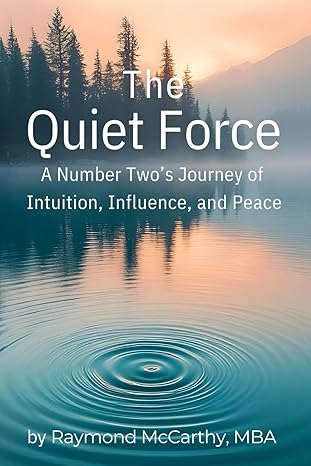
A Number Two's Journey of Intuition, Influence, and Peace — the definitive guide for those who lead from behind and shape the future without needing the spotlight.
About the Author
"For over three decades, I've lived a life most people wouldn't consider remarkable. I've never been the CEO, never had my name on a building. Instead, I've spent my career making other people successful."
Raymond McCarthy, MBA, is an executive coach, DISC behavioral consultant, and leadership strategist who has spent more than thirty years mastering the art of leading from behind. His journey spans the U.S. Army (where he was named Outstanding Platoon Leader during basic training), corporate boardrooms, small business leadership, and personal coaching.
Certified through the International Coaching Federation (ICF), Raymond is the founder of Rx4 Empowerment — a coaching and consulting practice dedicated to helping leaders live with intention, lead with heart, and leave something that matters. He is also a trained DISC behavioral analyst, helping teams and individuals understand how their natural styles shape leadership effectiveness.
"The world needs people who are secure enough to serve, confident enough to support, and wise enough to understand that true leadership isn't about position — it's about purpose."
The Book
The Quiet Force is not a book about settling for less — it's about discovering a different kind of power. The kind that shapes outcomes without needing signatures, influences decisions without demanding credit, and creates legacies that last long after the spotlight has moved on.
Through 11 chapters of hard-won wisdom, Raymond McCarthy shares what it truly means to lead from the second chair: the art of invisible influence, loyalty without silence, anticipation as an act of service, and the sacred nature of support. With foreword by Joe Stumpf, founder of By Referral Only.
"Your time in the shadows hasn't been preparation for something greater. It has been something greater all along."
— Raymond McCarthy, PrologueInside the Book
Each chapter is a deep dive into the principles that define great Number Two leadership — click any chapter to read more.
Joe Stumpf, who first met Ray McCarthy on a golf course over thirty years ago, describes watching Ray's unconventional swing — sailing far left before hooking back perfectly to the fairway — as a metaphor for everything Ray does. He doesn't take the obvious path, yet consistently delivers exactly what's needed.
Stumpf writes: "For thirty years, I've watched Ray embody every principle he writes about in this book. I've seen him anticipate challenges before they materialized, speak the truth when it was uncomfortable but necessary, and maintain unwavering loyalty even when circumstances tested that commitment."
To every Number Two reading this book — "You are not less than. You are not secondary. You are the backbone of every great achievement."
From the moment Raymond first realized his calling might not be to lead from the front but from behind, everything changed. Not a limitation — a liberation. This chapter explores the awakening that happens when you stop chasing the spotlight and begin to understand the profound fulfillment of facilitating others' achievements.
Raymond shares a pivotal community outreach experience where he worked behind the scenes — ensuring every detail was in place, anticipating problems before they arose — and witnessed the seamless execution he helped create. "Leadership isn't confined to the front lines. It's equally powerful — perhaps more powerful — when exercised through support, guidance, and empowerment."
Drawing on Nelson Mandela's insight that it is better to lead from behind and put others in front, Raymond invites readers to ask: Where do you find your greatest sense of purpose? Do you light up when others succeed because of something you contributed?
What part of you still believes you must be seen to be significant?
Real power doesn't always announce itself with fanfare and corner offices. Raymond shares a defining moment when he faced a critical deadline with key decision-makers absent. He made an executive decision to proceed — and the outcome succeeded, yet few knew of his involvement. No accolades. No recognition.
This chapter introduces the concept of "internal scorekeeping" — measuring success by alignment with your values rather than applause from others. When your motivation is anchored in purpose rather than praise, it becomes unshakeable. No one can take it away because it was never dependent on their approval.
Raymond explores the distinction between being invisible and being invaluable, and how the roots don't get seen but they're the reason the whole tree stands tall.
Where in your life are you seeking applause over alignment?
The moment Raymond realized that loyalty doesn't mean silence was the moment he became truly valuable as a Number Two. Real loyalty isn't about blind agreement — it's about having the courage to say what needs to be said, even when it's uncomfortable.
This chapter explores the dynamic of two strong DISC personalities working together and how respectful challenge becomes a tool for better outcomes. Raymond introduces the "Chief of Staff mindset" — a commitment to the organization's vision and the well-being of its people that transcends personal comfort.
He distinguishes between criticism (which attacks) and contribution (which builds) and explains how honest input — spoken not for ego but from deep conviction — shifts the trajectory of what's important. "Your voice, when used wisely and with good intention, doesn't threaten loyalty — it strengthens it."
When have you confused silence for support?
The difference between reacting to problems and preventing them isn't luck — it's disciplined attention. Raymond describes developing "anticipatory intelligence" through years in both corporate boardrooms and small business environments, sharpening an ability to read what's coming before it arrives.
Anticipation, he explains, is an act of empathy: "I see what you carry. Let me lighten it before you have to ask." He explores how to distinguish anxiety from intuition — intuition is quieter, it points rather than pleads, arriving with calm certainty rather than emotional noise.
Key practices: watching body language and unspoken signals, asking angled questions that create space for honesty, recognizing when someone's natural baseline has shifted, and staying calm in chaos by choosing to notice rather than react.
What patterns are you sensing before others name them?
There's a specific kind of pain that comes with pouring your heart, mind, and energy into something important, only to watch the credit flow elsewhere. It's not jealousy — it's the quiet ache of being essential but invisible. This chapter addresses that pain with honesty and compassion.
Raymond describes moments when contributions went unnoticed, when his name wasn't called, and the spiral of internal questioning that followed. He developed an internal protocol: Pause. Breathe. Wait. Process later. That rhythm allowed him to stay composed and find clarity after emotions cooled.
What's helped him find peace: grounding in self-satisfaction rather than external validation, accepting that recognition is unpredictable, and discovering that the most meaningful validation is the kind that comes from within. "Peace, I've come to believe, is a more faithful companion than praise."
What truth about your contribution do you wish someone would see?
The line between healthy confidence and destructive ego is thinner than most realize. Ego seeks validation, demands recognition, and grows anxious when the spotlight fades. Confidence, on the other hand, is quiet, steady, and internally sourced. This chapter explores how Raymond learned to distinguish between the two.
Drawing on Norman Vincent Peale's "The Power of Positive Thinking" — a book he has carried since youth — Raymond was given permission to hold strength and humility in the same hand. Real power doesn't shout. It steadies the room. It listens before it moves. It elevates without needing to outshine.
He introduces the practice of setting a daily intention: "Today, I will create a positive impact, whether for myself or for someone else." And the gentle art of calling out ego in others — not with confrontation, but with soft strength that re-centers the focus on the collective goal.
What would change if your validation came from within?
The most powerful partnerships aren't built on hierarchy — they're built on harmony. When a Number One and Number Two truly align, they create something that transcends what either could accomplish alone. This chapter opens a window into Raymond's decades-long partnership with Terry, built through mutual awareness, DISC understanding, and shared experience.
Two high-D personalities can either clash or collaborate — it depends entirely on respect. Their breakthrough came when they realized that respect wasn't just about tone; it was about giving each other room to lead, space to think, and the benefit of the doubt in high-pressure moments.
Raymond also addresses the art of helping without enabling, navigating financial hardship together (choosing to repay every dollar of debt rather than walk away), and the daily practices of connection that keep a partnership honest, fresh, and emotionally safe over decades.
What makes your partnership sacred — not just strategic?
The difference between good outcomes and great ones often lies in the small details that most people overlook. Raymond tracks scheduling and timing, emotional pressure points, and operational signals — not for control, but for consciousness. These details may never appear in a report, but they're the glue that keeps things from falling apart when no one else is watching.
His approach to overwhelm: slow down, not speed up. Stop. Listen. Then ask the "Question Behind the Question" — not just what needs to be done, but what's driving this? What's the ripple effect? This approach transforms overwhelm from a task problem into a clarity problem.
He describes the Chief of Staff mindset — never walking into a day, meeting, or decision without thinking two steps ahead — combined with the flexibility to augment, adjust, and reorient quickly when reality shifts. "Build systems with care, hold them with humility, and always leave room for humanity."
What details are you carrying that no one else can?
The most powerful influence you'll ever have might come not from what you teach directly but from what people learn by watching how you handle the moments when you think no one is looking. Raymond explores the shift from being someone who executes to someone who influences — mentoring others simply by how he carried himself through challenges.
He recounts the transformative experience of earning his coaching certification through the International Coaching Federation — not to acquire a credential, but to recognize and honor what he'd already been doing for years: listening with care, asking the right questions, and helping people see their path more clearly.
A guiding inspiration: legendary manager Sparky Anderson, whose kindness and humility on the golf course showed Raymond that greatness isn't in how loudly you speak — it's in how deeply your actions resonate in the lives of others. "Legacy doesn't require a microphone. Sometimes it only requires consistency, character, and the courage to keep showing up, especially when no one's watching."
What are you modeling — intentionally or not — for those around you?
There comes a moment when every Number Two must ask: Am I meant to stay in this role forever, or is something new calling me forward? This chapter addresses that question with honesty, nuance, and deep respect for both paths. Stepping forward isn't about ego — it's about recognizing when the season of support has prepared you for something different.
Raymond shares his military story: selected to lead a platoon of over 65 recruits during basic training, earning the Outstanding Platoon Leader award. Not because he knew everyone, but because someone saw his capacity to lead under pressure. "Leadership is about presence under pressure. It's about doing the job even when the outcome is uncertain."
Signs you may be outgrowing your current role: feeling unchallenged in high-output environments, sensing you've stopped learning and started simply performing, receiving feedback that your voice is ready to carry more weight. True loyalty doesn't mean staying small. It means staying committed to the shared vision — even when that requires stepping forward to help it evolve.
Is it time to remain behind the scenes — or to answer the call to lead?
After walking this path for over three decades, Raymond distills the deepest insights from a life of leading without applause. These 21 principles go beyond technique or strategy — they are the truths that emerge only when you have committed to excellence without recognition, to influence without credit.
A sample of the 21 insights: The Liberation of Letting Go of the Spotlight · The Art of Invisible Influence · Loyalty Transcends Agreement · Anticipation as an Act of Service · Finding Peace in Professional Invisibility · The Distinction Between Ego and Confidence · Sacred Synergy in Partnership · Mastery Without Overwhelm · Teaching Through Quiet Example · The Courage of Stepping Forward · Emotional Intelligence as Foundation · The Power of Patient Presence · Integrity as Competitive Advantage · Strategic Vulnerability · Graceful Boundaries · Building Legacy Through Relationships · Wisdom in Seasons of Service · The Multiplication Effect of Trust · Navigating Success Without Losing Yourself · The Sacred Nature of Support · Living Your Purpose Fully.
These twenty-one insights are invitations to a way of being that honors both the individual calling to serve and the collective need for leaders who care more about impact than image.
What People Are Saying
"Ray McCarthy has embodied every principle in this book for over thirty years. I've watched him anticipate challenges before they materialized, speak truth when it was uncomfortable, and maintain unwavering loyalty when it was tested. He is the strength behind the strength."
"The Quiet Force gave me language for something I'd always felt but never been able to articulate. I've spent my career making others successful — and this book finally celebrates that as a calling, not a consolation prize."
"I've read dozens of leadership books. None of them spoke to my actual experience — until this one. Raymond McCarthy doesn't just describe the role; he honors it. A must-read for every trusted advisor, project manager, and second-in-command."
Common Questions